


The promise of generative AI in software engineering has evolved beyond simple code completion. The current frontier is agentic coding, where AI systems can plan, execute multi-step changes, and iterate based on feedback. Despite significant excitement around these AI coding agents, a substantial number of enterprise deployments are underperforming. The critical limiting factor is not the AI model itself, but context – the intricate structure, history, and intent surrounding the code being modified. Enterprises are now facing a fundamental systems design challenge: they haven’t yet engineered the operational environment for these agents.
The Shift from Assistance to Agency
Over the past year, there has been a swift transition from assistive coding tools to more sophisticated agentic workflows. Research is formalizing agentic behavior, defining it as the capability to reason across design, testing, execution, and validation, rather than merely generating isolated code snippets. Innovations like dynamic action re-sampling demonstrate that enabling agents to branch, reconsider, and revise their decisions significantly enhances outcomes in large, interdependent codebases. Major platforms like GitHub are actively developing dedicated agent orchestration environments, such as Copilot Agent and Agent HQ, to facilitate multi-agent collaboration within enterprise pipelines.
However, early field results highlight a cautionary tale. When organizations deploy agentic tools without adequately addressing workflow and environment, productivity can actually decrease. A randomized control study conducted this year revealed that developers using AI assistance within unchanged workflows completed tasks more slowly, primarily due to increased verification, rework, and confusion regarding intent. The straightforward lesson is that autonomy without proper orchestration seldom leads to efficiency.
Why Context Engineering is the Real Unlock
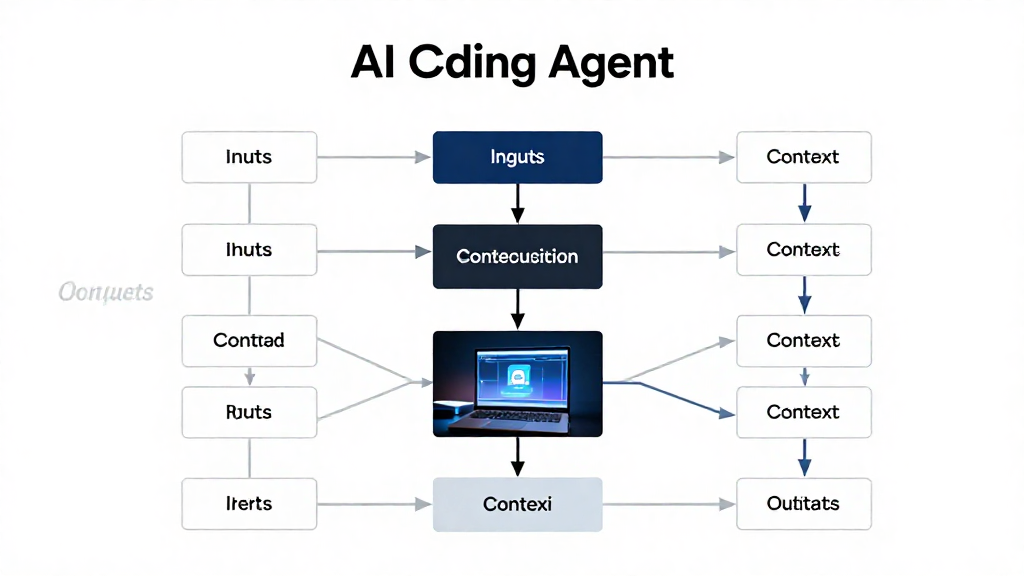
In nearly every unsuccessful deployment observed, the root cause of failure has been a lack of sufficient context. When AI agents lack a structured understanding of a codebase—including its relevant modules, dependency graph, test harness, architectural conventions, and change history—they tend to produce output that appears correct in isolation but is detached from the broader reality of the project. Overloading the agent with too much information can be as detrimental as providing too little, forcing it to guess. The objective is not to simply feed the model more data (tokens), but to precisely determine what information should be visible to the agent, when, and in what format.
Teams achieving meaningful gains treat context as a critical engineering surface. They develop tooling to snapshot, compact, and version the agent’s working memory, carefully managing what is persisted across interactions, what is discarded, what is summarized, and what is linked rather than inlined. They design deliberate steps for reasoning rather than relying solely on prompting sessions. The specification becomes a first-class artifact—reviewable, testable, and owned—instead of a transient chat history. This approach aligns with the emerging trend where “specs becoming the new source of truth.”
Workflow Must Change Alongside Tooling
Context alone is insufficient; enterprises must also re-architect the workflows surrounding these agents. As highlighted in McKinsey’s 2025 report, “One Year of Agentic AI,” productivity gains stem not from layering AI onto existing processes but from fundamentally rethinking the process itself. Simply integrating an agent into an unaltered workflow invites friction, leading engineers to spend more time verifying AI-generated code than they would have spent writing it themselves. AI agents amplify existing structures: well-tested, modular codebases with clear ownership and documentation are essential. Without these foundations, autonomous agents can lead to chaos.
Security and governance also necessitate a shift in mindset. AI-generated code introduces novel risks, including unvetted dependencies, subtle license violations, and undocumented modules that bypass peer review. Mature organizations are integrating agentic activity directly into their CI/CD pipelines, treating agents as autonomous contributors whose work must undergo the same static analysis, audit logging, and approval gates as human developers. GitHub’s documentation emphasizes this trajectory, positioning Copilot Agents as orchestrated participants within secure, reviewable workflows, not replacements for engineers. The aim is not for AI to “write everything,” but to ensure its actions occur within defined guardrails.
What Enterprise Decision-Makers Should Focus On Now
For technical leaders, the path forward emphasizes readiness over hype. Monolithic applications with sparse tests are unlikely to yield net gains; agents thrive where tests are authoritative and can drive iterative refinement, a loop that Anthropic identifies as crucial for coding agents. Pilot programs should focus on tightly scoped domains such as test generation, legacy modernization, or isolated refactors. Each deployment should be treated as an experiment with explicit metrics like defect escape rate, PR cycle time, change failure rate, and security findings burned down. As usage expands, agents should be viewed as data infrastructure, where every plan, context snapshot, action log, and test run contributes to a searchable memory of engineering intent, forging a durable competitive advantage.
Fundamentally, agentic coding is less a tooling problem and more a data problem. Each context snapshot, test iteration, and code revision generates structured data that must be stored, indexed, and reused. As these agents become more prevalent, enterprises will manage an entirely new data layer capturing not just what was built, but how it was reasoned about. This transforms engineering logs into a knowledge graph of intent, decision-making, and validation. Organizations capable of searching and replaying this contextual memory will ultimately outperform those who still treat code as static text.
The coming year is critical in determining whether agentic coding becomes a cornerstone of enterprise development or another overhyped promise. Success hinges on context engineering: how intelligently teams design the informational substrate their agents rely on. The winners will be those who perceive autonomy not as magic, but as an extension of disciplined systems design, characterized by clear workflows, measurable feedback, and rigorous governance.
Bottom Line
Platforms are increasingly converging on orchestration and guardrails, while research continues to enhance context control at inference time. The leaders in the next 12 to 24 months will not be those with the most advanced models, but rather the teams that engineer context as a strategic asset and treat workflow as the core product. Mastering this approach allows autonomy to compound; neglecting it leads to a backlog of verification and rework.
Context + Agent = Leverage. Skipping the context half means the entire equation collapses.
Based on reporting from VentureBeat. Read full report.