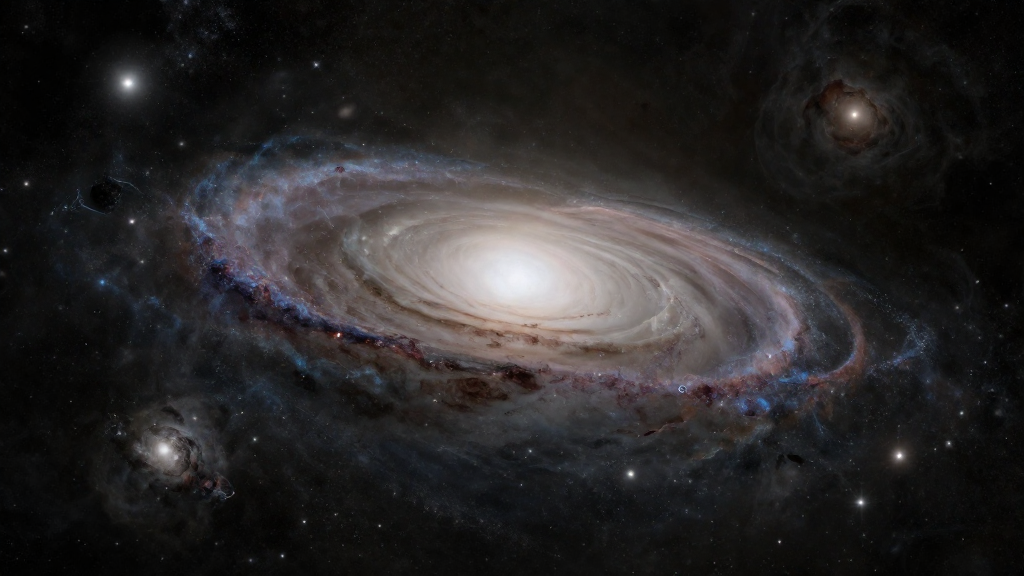

When we gaze at the night sky through telescopes, the universe appears to be a dazzling spectacle of galaxies, each containing billions of stars and their orbiting planets. Central to many of these galaxies are supermassive black holes, adding to the cosmic grandeur. It’s natural to assume that these colossal structures—stars, planets, and galaxies—harbor the vast majority of matter in the cosmos.
However, according to an astronomer’s explanation, this common perception is incorrect. The majority of the universe’s normal matter is not found within the familiar celestial bodies we observe.
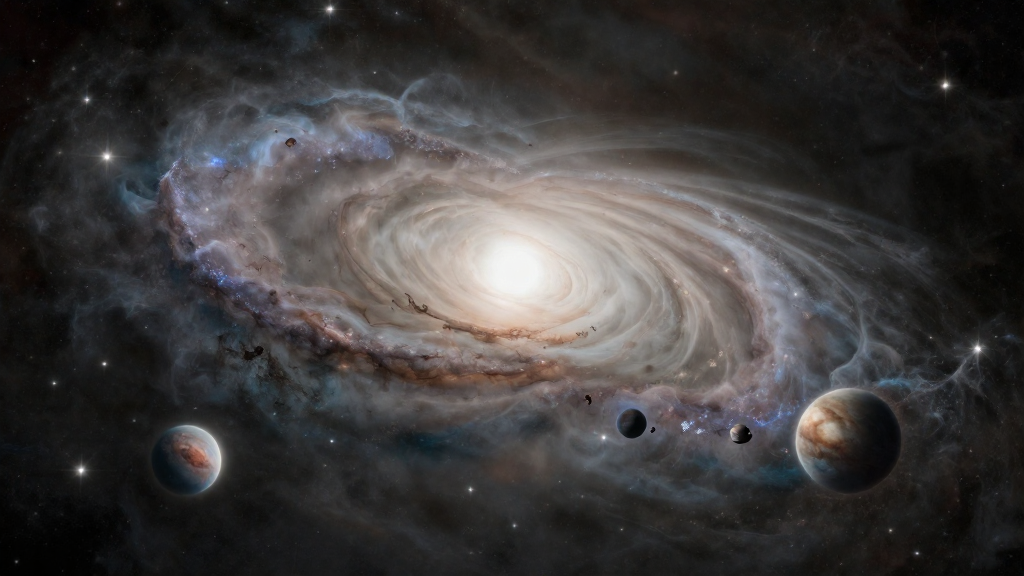
The Universe’s Missing Matter?
While galaxies, stars, and planets are visually striking and contain significant amounts of matter, they represent only a fraction of the total baryonic (normal) matter in the universe. The remaining, and indeed the largest portion, is thought to exist in the vast, diffuse spaces between galaxies, often referred to as the Warm-Hot Intergalactic Medium (WHIM).
This intergalactic medium is composed of hot gas and plasma that is too faint and spread out to be easily detected by traditional telescopes. It’s essentially the cosmic scaffolding upon which galaxies form and evolve.
Implications for Cosmology
Understanding the distribution of matter is crucial for comprehending the formation and evolution of the universe. The unseen matter in the intergalactic medium plays a significant role in the large-scale structure of the cosmos and influences how galaxies cluster together.
Future astronomical observations and advancements in detection technology are key to better understanding and mapping this elusive component of the universe.
Based on reporting from Phys.org. Read full report.