

A groundbreaking paper set to be presented at NeurIPS 2025 demonstrates that self-supervised learning techniques can imbue Vision Transformer (ViT) models with a superior understanding of images compared to traditional supervised learning methods that rely on explicit labels.
The research, titled “Do Labels Make AI Blind? Self-Supervision Solves the Age-Old Binding Problem,” challenges the long-held assumption that labeled data is essential for robust AI image recognition. The study specifically investigates the “binding problem” in AI – how different features of an object are correctly associated and understood as a cohesive whole.
Key Findings: Emergent Object Binding
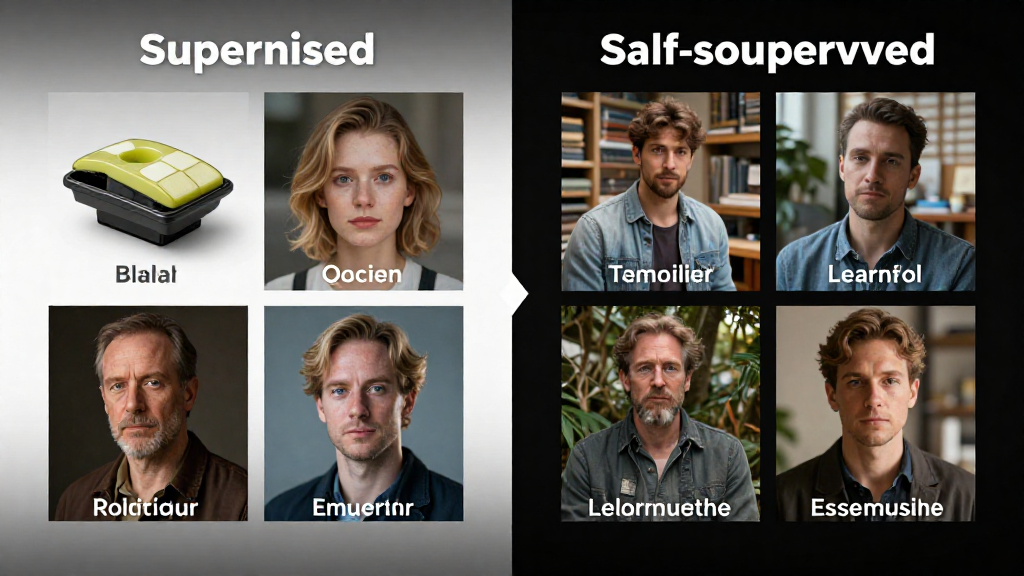
The core of the paper’s findings revolve around the concept of emergent object binding. Traditionally, supervised learning models are trained on datasets where images are meticulously labeled with specific objects and their attributes. While effective for many tasks, this approach can sometimes lead to AI systems that are “blind” to the underlying relationships between an object’s parts or its context, especially when presented with novel or slightly altered inputs.
In contrast, the NeurIPS 2025 paper shows that self-supervised learning, where models learn by identifying patterns and relationships within unlabeled data, naturally develops a more nuanced understanding of object composition. This means ViTs trained with self-supervision are better at understanding how different visual elements bind together to form a complete object, a critical capability for real-world AI applications.
Implications for AI Development
This research has significant implications for the future of AI development:
- Reduced Reliance on Labeled Data: Labeling large datasets is a time-consuming and expensive process. Self-supervised learning offers a path to train powerful models with significantly less human annotation.
- Enhanced Robustness: Models that understand object binding are likely to be more robust to variations in viewpoint, lighting, and occlusion, as they grasp the inherent structure of objects.
- Improved Generalization: A deeper, more fundamental understanding of visual elements could lead to AI systems that generalize better to new tasks and unseen data.
The study suggests that the very act of relying on explicit labels might, in some ways, limit the AI’s ability to learn the fundamental principles of visual perception. Self-supervised methods, by forcing the model to infer structure from raw data, appear to circumvent this limitation, leading to more capable and adaptable AI systems.